

AI Isn’t Replacing Media Training. It’s Raising the Stakes.
Media training in the AI era requires precision, alignment and narrative discipline as AI systems archive and amplify executive interviews.

Over the past several months, I’ve found myself reframing how I talk about media training with clients. Not because the fundamentals have changed, but because the environment has.
Generative AI tools have moved from experimentation to daily workplace use. According to a 2025 Pew Research Center study, roughly 20 percent of U.S. workers now use AI in their jobs, up significantly from the prior year.
That statistic matters more than it first appears.
When professionals use AI tools to summarize companies, analyze industries and answer real-time questions, every executive interview becomes part of a larger data ecosystem. Everything from quotes and commentary to positioning statements are routinely scraped and synthesized into machine-generated responses.
Media training in the AI era prepares leaders for both human and machine audiences. Every interview now feeds systems that summarize, synthesize and archive executive language.
What used to be a moment is now a data point, and that shift raises the stakes for how leaders prepare. For organizations already investing in executive media training, the mandate is no longer just confidence and polish. It is precision and durability.
Why AI Changes Media Training
AI systems archive executive language indefinitely, turning every interview into a permanent record that can be retrieved and reused. They detect repetition across sources, elevating phrases that appear consistently and reinforcing them as defining narratives.
Research from MuckRack shows that only 27 percent of AI search citations come from traditional media, meaning the rest come from brand-owned or secondary sources—further proof that consistent executive messaging across every outlet now directly shapes how AI summarizes organizations. They also flatten nuance, compressing complex answers into simplified summaries that may lose context. Over time, small inconsistencies across spokespeople are interpreted as patterns, shaping how organizations are represented in machine-generated responses.
Media Moments Now Compound
Earlier in my career, we often worked with news cycles that moved quickly. A tough quote might sting for a few days and then fade. Today, interviews don’t fade. They accumulate.
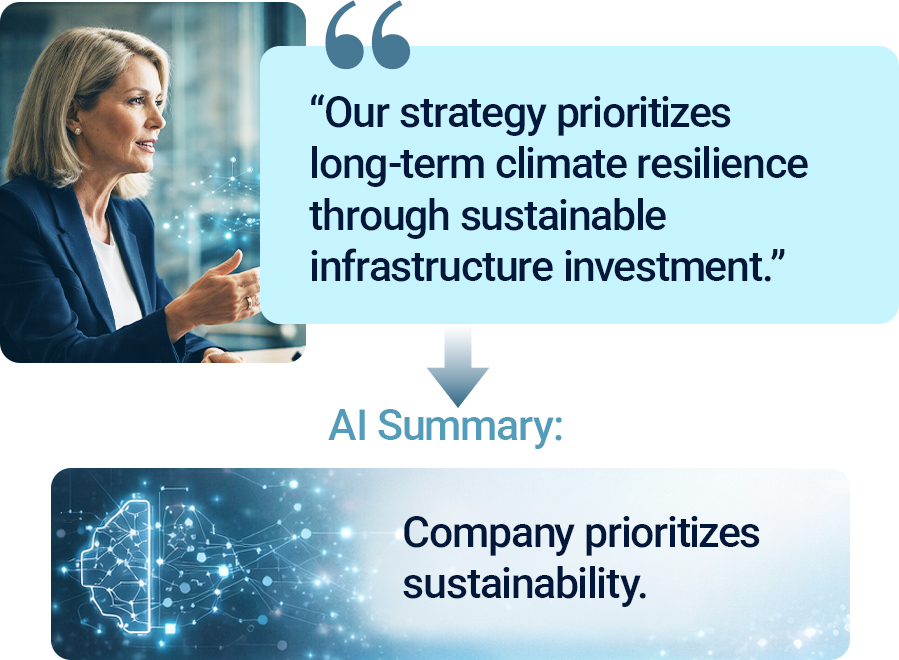
AI systems don’t interpret intent. They detect patterns. If a leader speculates, overgeneralizes or speaks inconsistently across interviews, that language can (and will) be distilled into a simplified narrative about the organization.
I advise client partners to treat interviews as long-term narrative inputs rather than isolated events. Today, preparation is about shaping language that can travel intact across platforms and over time.
AI Citation reality: Research confirms that AI systems reward repetition and brand-managed clarity. In fact, a Yext study found that 86 percent of AI citations originate from brand-managed sources, underscoring why disciplined, consistent executive language is essential to shape how organizations are summarized in machine-generated answers. Narrative discipline is no longer stylistic — it’s infrastructural.
Precision Is Now a Risk Management Discipline
Let’s be clear: both presence and delivery still matter. But clarity now carries operational implications. AI rewards structure and repeatable phrasing. Vague answers are more likely to be flattened into oversimplified summaries. Hedged responses can lose nuance entirely.
(W)right On’s training philosophy places greater emphasis on:
- Clear positioning in the first sentence
- One supporting proof point
- Defined boundaries around speculation
Rather than scripting, our strategy strengthens client partners’ thinking under pressure.
The leaders who perform best are not always the most charismatic. They’re the most disciplined.
Consistency Shapes How You Are Interpreted
One of the most common issues we see in media training sessions is inconsistency across spokespeople. Slight shifts in language may feel harmless in the moment. Over time, however, they fragment the narrative.
AI synthesizes what repeats. It does not reconcile nuance. That is why alignment across executive teams has become even more critical, especially in high-visibility environments where crisis communications strategy and media exposure intersect.
When organizations treat media training as episodic, they miss the opportunity to build narrative infrastructure. When they treat it as strategic, they build resilience.

What Has Not Changed
AI has not created new reputational risks. Leaders still create exposure by:
- Overpromising
- Speaking before internal alignment
- Reacting emotionally
- Speculating beyond their authority
What AI does is amplify and archive those vulnerabilities. The fundamentals of strong media training remain intact. What has changed is the permanence of interpretation.
Leading in an AI-Shaped Environment
In recent client partner conversations, I return to one theme: media training is no longer just about performing well in the moment. It’s about governing how your organization is represented in systems you do not control.
Media training as a discipline is not fading. If anything, it’s becoming more essential inside reputation strategy. The stakes are simply higher.
If your executives are increasingly visible or operating in high-scrutiny environments, it may be time to evaluate whether your current media training approach reflects today’s AI-shaped reality. We would welcome that conversation.
Frequently Asked Questions
How does AI affect media training?
AI systems archive and synthesize executive interviews, meaning unclear or inconsistent messaging can be amplified and repeated in machine-generated summaries.
Is media training still necessary in the AI era?
Yes! Media training is more important than ever because executive language now shapes long-term digital narratives across AI systems.
What is AI narrative risk?
AI narrative risk occurs when speculative or inconsistent executive statements are distilled into simplified summaries that persist across platforms.
David Cumpston is Associate Vice President of (W)right On Communications, a senior-led strategic communications agency helping destinations and mission-driven brands build trust, credibility and long-term relevance.
Are you reassessing how your organization protects its reputation in an era of machine-generated narratives? Let’s talk: (858) 886-7900 or info@wrightoncomm.com.