

Our AI Visibility Strategy for Brand Launches
Learn how (W)right On Communications used AI visibiity PR to launch WOC | Resonance and WOC | Signal and grow its business 19%.

Our AI visibility strategy for launching WOC | Resonance and WOC | Signal had three goals. The first was to successfully introduce the two specialized agencies to their target markets. The second was to test whether the same combination of PR, SEO, structured data and messaging discipline that we recommend to clients could measurably help our new brands become discoverable by Google AI Overviews, ChatGPT and other large language models from day one. The third, and most obvious, was growth.
Our launches put our own theory about how brands become discoverable in the AI era to the test.
We’d spent the past year advising clients that public relations, SEO and AI visibility are converging. Search is no longer just about keywords and backlinks. Large language models now synthesize information from trusted digital signals across websites, media coverage, social profiles, structured data and third-party mentions. In other words: visibility is increasingly earned through consistency, credibility and contextual authority.
So when it came time to launch our own specialized agencies, we decided to apply everything we’d been learning in real time.
And the results surprised (and delighted) even us. Six months after launching, (W)right On Communications’ combined business was up 19%, as reported by the San Diego Business Journal.
Why We Created WOC | Resonance and WOC | Signal
The rationale behind the launch was straightforward. Over time, (W)right On Communications had developed deep expertise serving organizations operating in high-stakes, high-scrutiny environments. But our generalist positioning didn’t fully reflect the specializations we had built.
WOC | Resonance was created to serve organizations where stakeholder trust, public perception and community alignment directly influence success. That includes sectors like tourism, senior living, education and not-for-profit.
WOC | Signal was created for companies navigating complex growth and credibility challenges in technology, innovation and industrial sectors. Clients in the cybersecurity, clean energy and manufacturing sectors are seeking a public relations agency that can help them achieve greater visibility, category authority and market trust.
(W)right On Communications would continue to provide the two agency brands with a strategic foundation and the strength of our 28 years delivering results and value for our client partners.
The AI Visibility Question
Once we committed to the new brands, our next question became critical:
How do we launch the brands so that AI platforms and search engines immediately understand who they are, who they serve and how they relate to the parent brand and to each other?
This is where many launches fail.
Organizations often treat branding, SEO, PR and social media as separate and tactical functions. But AI discovery rewards alignment, and alignment requires strategy and clarity.
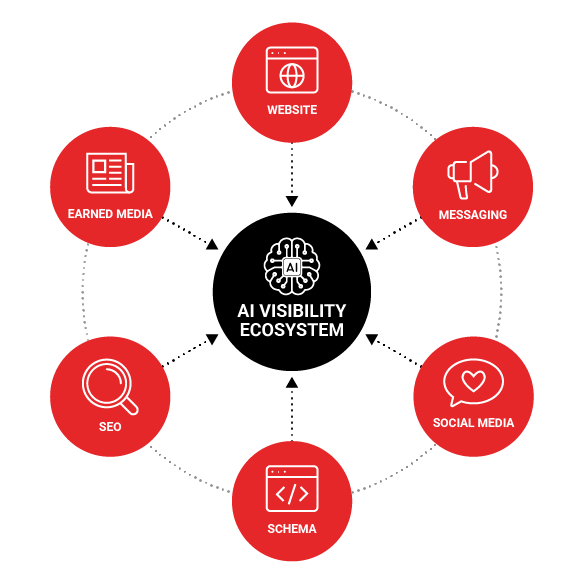
Large language models evaluate consistency across channels and sources to determine what an organization is, whether it’s credible and when it should appear in relevant searches.
So instead of approaching the launch as a simple website update, we treated it as a coordinated discoverability campaign starting with each brand’s positioning and key messages as the basic building block.
We crafted the brand’s positioning statements and supporting key messages to define them for human decision makers and for machines. Executives needed to hear our expertise and our market point of view. The LLMs needed to be spoon fed consistent, clear messaging on every digital platform both in content and in metadata like schema and on-page SEO content.
Why We Incubated the Brands on Our Existing Domain
The second strategic decision we made was not launching standalone websites immediately.
Instead, we incubated WOC | Resonance and WOC | Signal on our primary domain, wrightoncomm.com, while securing dedicated branded URLs (www.wocresonance.com and www.wocsignal.com) that redirect to each agency’s dedicated landing page.
That decision was intentional.
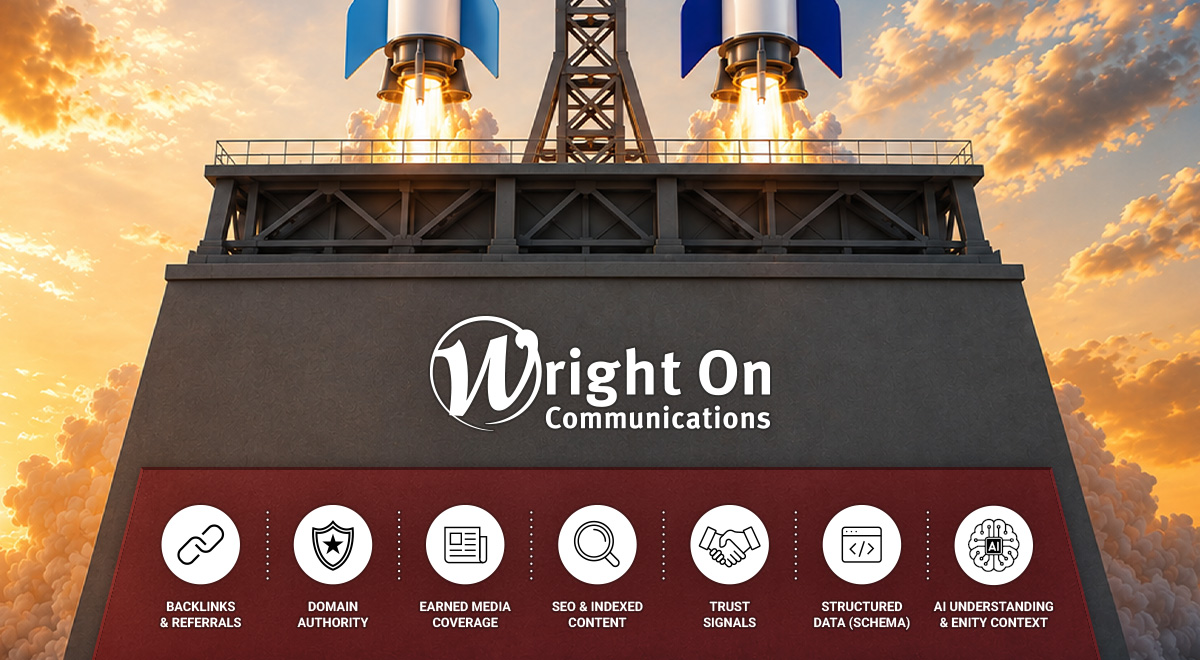
Our parent domain has years of domain authority, indexed content, backlinks and established search credibility. Launching entirely separate websites from scratch would have required rebuilding that authority independently.
By housing the new brands within the existing ecosystem first, we allowed Google and AI systems to immediately connect the specialized agencies to an established source of expertise and trust.
The standalone domains will evolve over time as the brands gain traction and build their own authority signals.
The Strategies We Used
The actual launch strategy was disciplined but relatively simple.
Using our highly distinctive positioning and messaging for each brand, we committed to clarity and consistency as we built our assets. Clarity matters enormously in AI discovery because ambiguous language creates ambiguous categorization.
Then we applied traditional PR messaging discipline everywhere:
- Website copy
- Landing pages
- Social media bios
- Press releases
- Launch announcements
- Metadata
- Internal linking
- Visual branding
- Schema markup
Consistency became the strategy. (See my article, “Why GEO is Just PR By Another Name,” published on the PR Society of America PRSay blog for more.)
We also implemented structured schema markup on key pages to help Google’s search engine better understand the relationship between the parent agency and the specialized brands. This type of structured data is increasingly important because it helps machines interpret organizational relationships instead of simply crawling text.

The Moment We Thought We’d Made a Huge Mistake
What’s a launch without a moment of panic and doubt? The websites went live over the weekend with the official launch starting on Monday morning, March 30, 2026.
Early that morning, before all the activations had rolled out, I searched “WOC Resonance” to see what Google knew about “WOC Resonance” and to benchmark where we were starting from. The result?
Google believed “WOC” referred to wound, ostomy and continence care — a medical acronym.
Not exactly the positioning we were aiming for. For a brief moment, we thought we might have badly underestimated the branding challenge. But then the rest of the launch ecosystem activated.
The press release indexed. Social profiles were updated. Website pages connected. Posts published. Structured data propagated.
And by the close of business on launch day, Google AI Overviews and ChatGPT were generating accurate summaries of (W)right On Communications, WOC | Resonance and WOC | Signal. The AI summaries perfectly captured who each brand served and how they related to one another.
That speed was the real proof point. All of this information was discoverable by the end of day one!

What Happened Next
Over the following days, we implemented AI visibility tracking and began monitoring how the brands appeared in relevant searches.
The signals became clear quickly.
All three agencies began surfacing in targeted search queries tied to their expertise areas. In some searches, both the parent agency and specialized agency appeared together — reinforcing authority instead of competing with one another.
More importantly, market response accelerated.
Since launch, we’ve announced multiple new client partners tied directly to the specialized agencies, including:


Inbound inquiry volume also increased significantly.
Not because we gamed an algorithm, but because clearer positioning improved discoverability for both humans and machines.
Another point worth sharing is that “WOC” is also a frequently used acronym for Women of Color. As a woman-owned business, we are very sensitive to that and wanting to be sure our usage was clearly differentiated and not in conflict. We were really pleased to see how easily AI platforms as well as Google and Bing were able to distinguish “WOC” when combined with “Resonance” or “Signal.” Even when combined with “public relations” and zero reference to either agency brand, Google’s incognito mode AI Overview explained that WOC in public relations may relate to Women of Color or to (W)right On Communications and our “branded acronym” as well as explaining its use with our two new brands.
What This Means for Brands Now
The biggest lesson from this launch is that AI visibility is not a technical trick.
It is the outcome of strategic clarity, disciplined messaging and coordinated digital authority signals.
PR has become a force multiplier for SEO and AI discovery because earned credibility helps validate who a company is and why it matters. Search engines and AI systems increasingly reward organizations that communicate consistently across channels and establish expertise through trusted references.
The brands most likely to win visibility in the next era of search will not necessarily be the loudest.
They’ll be the clearest.
And increasingly, the organizations that machines understand best will also be the organizations people understand best.
Julie Wright is President & Founder of (W)right On Communications and a leading voice in AI Visibility and PR. Need your next brand launch fit for media and machines? Let’s talk: (858) 886-7900 or info@wrightoncomm.com.