

Newstinction: AI and Journalism’s Existential Crisis
AI’s easy answers may be journalism’s undoing as they strip traffic and ad revenue from news sites, and original reporting faces “Newstinction.”

Over the past 20 years, the news business has been gutted by Craigslist, digital fragmentation and falling social media referral traffic. Now, in rides Artificial Intelligence — basically, the fourth horseman of the newspocalypse. AI’s timing couldn’t be worse as the free press in the U.S. is already in an existential struggle against the aforementioned technological forces as well as a very antagonistic federal administration.
How is AI harming journalism’s business model? Platforms like OpenAI, Google and Perplexity scrub and summarize journalism’s outputs to deliver convenient, concise answers without driving any eyeballs to news sites. By inserting themselves between readers and reporting, answer engines prevent news organizations from monetizing their journalism investments through advertising.
Since ChatGPT’s meteoric rise in late 2022, journalism website traffic has seen steep declines. When Google introduced its AI Overviews in May 2024, organic traffic took another big tumble.
Between 2024 and 2025, organic news site traffic fell by 5% for the New York Times, 32% for CNN and 57% for U.K. publisher The Sun. Last year, Business Insider cut its workforce by 21% after its traffic fell 44%. Huffington Post’s traffic dropped 41%, and it made a 22% workforce reduction. This trend is projected to continue. The Reuters Institute surveyed global news media leaders who are bracing for a further 40% slide over the next three years.
That’s why it’s time to talk about what I’m calling newstinction. What is newstinction? It’s the economic end of the road for traditional journalism. It’s not driven by lack of demand for information but by structures that are stripping value from its production.
Is “Newstinction” a Real Possibility?
I, ironically, asked Google Gemini to help me calculate the point at which newstinction could be a possibility as these declines continue to play out. Gemini said:
“If we treat ‘the news’ as a mathematical variable based on traditional newsroom employment, the data suggests a timeline of extreme scarcity—though not necessarily total ‘extinction’—within the next two decades.”
Gemini didn’t indicate whether it thinks extreme scarcity is good news or bad news, but it did paint out potential future scenarios for the 2030s and 2040s. One scenario was “Ghost Newsrooms” staffed by skeleton crews of one to two journalists who aggregate social media feeds and press releases to produce news. Another was bespoke subscription-based journalism for the wealthy while the masses receive algorithmic content or content from influencers.
A glimmer of hope, at least to me, are nonprofit news models that have been filling some of the gaps in local news gathering as well as investigative reporting, which is expensive but vital. Another counterpoint is Substack, which has been growing as a publishing platform serving individual journalists and commentators. But it’s not the same as having the resources of a news organization, and success on Substack is heavily dependent on having a big following which leads to personality journalism, like former CNN anchor Don Lemon’s feed.
Original reporting is foundational to democracy, accountability and shared understanding. But it’s not doing so great, and AI could be the proverbial pillow over its face.
Journalism as an AI “Externality”
Economists define an externality as a cost or benefit not reflected in market prices. For example, pollution is a negative externality associated with combustion engines while vaccinations or teachers’ salaries are unpriced societal benefits.
This is how it is with original reporting and artificial intelligence. Society benefits from things like in-depth investigations, reporting from dangerous places, fact checking and gathering eyewitness accounts. AI systems are ingesting that reporting to generate answers, but the value created by journalists is not captured or compensated. (Another big externality from AI is its environmental impacts, of course.)
If Google had to compensate news outlets for the traffic it diverts through AI Overviews, it would cost Google about $200 million per month or over $2 billion per year, based on Google Gemini’s own math:
| Publisher Scale | Est. Monthly Search Clicks Lost1 | Avg. CPM (News)2 | Monthly Lost Revenue3 |
| National (Top Tier) Ex. CNN, NY Post | 50,000,000 | $10.00 | $500,000 |
| Mid-Market / Regional LA Times, Boston Globe | 5,000,000 | $7.00 | $35,000 |
| Industry-Wide (U.S.) | ~1.2 Billion (est.) | $8.50 | ~$200,000,000 |
1 22-33% decline in traffic from Google Search in 2025
2 Ranges from $5-12 (CPM = cost per 1,000)
3 Excludes the “data value” of the content being used to train the very models that are replacing the traffic.
Some money is exchanging hands between news organizations and AI platforms. OpenAI paid a reported $250 million for access to News Corp’s assets like the Wall Street Journal. It also inked deals with Axios for $25-30 million over three years, the Financial Times for $5-$10 million per year and Associated Press for a smaller figure that only allows access to its archive for training.
But the bottom line is that less revenue for news equals less original reporting, even as society craves more credible information.
Public Support Retreats Just as Journalism Needs It Most
Market failures are often opportunities for government intervention like subsidies or regulation. But in the U.S., that’s unlikely. If anything, the federal government is actively eroding the power of the free press and/or blocking or controlling journalists’ access to elected officials and policymakers.
Last May, the White House stopped federal funding for National Public Radio and the Public Broadcasting Service through the Corporation for Public Broadcasting (CPB), and Congress later cut funding for fiscal years 2026 and 2027. So, after 58 years providing independent, educational content free from market pressures, the CPB went dark. NPR and PBS carry on as nonprofits but are entirely dependent on donations, grants and sponsorships.
In October, dozens of legacy news organizations forfeited Pentagon press passes rather than accept new rules that would limit their coverage to pre-approved news. These media organizations are cultivating sources and working off-site to continue their reporting.
And just this week, a Washington Post reporter was subjected to an FBI raid on her home looking for information about one of her sources. The FBI seized her phone, work and personal laptops as well as a Garmin smartwatch. The U.S. Justice Department previously had a policy prohibiting the seizure of a reporter’s communications data.
Consolidation and Influence in Legacy Media
Economic pressure often leads to consolidation, and U.S. legacy media is not immune. Consolidation reduces the number of perspectives and diversity of voices and viewpoints.
CBS News is now under new parent company Paramount Global with billionaire class ownership. A new head of news at CBS was installed by the new ownership who is more aligned with the White House’s views and no experience in network news. Journalists and observers are concerned about its editorial independence, political alignment and operational competency.
Shrinking resources can make outlets more susceptible to commercial or political pressure, challenging the traditional firewall between editorial judgment and external influence.
Why “Newstinction” Matters to Everyone
The danger of newstinction should be obvious to anyone, but to be explicit, it’s about the loss of verified, trustworthy, context-rich information. The kind of information that keeps governments accountable, communities informed and the town square grounded in fact.
News deserts are cropping up across the U.S. where 225 counties don’t have any local news source and half of all U.S. counties have just one news source.
If original reporting is about to be referred to hospice, then history’s first draft is very close to being written by Ghost Newsrooms at best and government-sanctioned sources at worst.
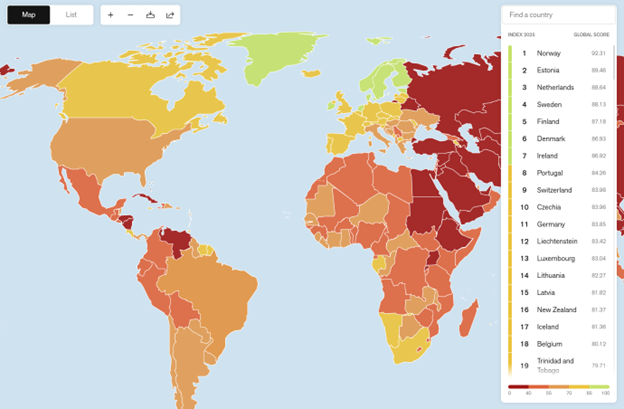
For over 10 years, the Global Press Freedom Index has been produced by Reporters Without Borders. This past year, it fell to a new low with the average score below 55 points and the majority of countries tracked seeing declines. So, this is not a uniquely American problem although a very concerning trend in what has historically been the world’s biggest champion of democracy.
What You Can Do to Support a Free Press
If you believe journalism matters, here are concrete ways to help sustain it:
- Support legal defense and advocacy groups that defend press freedom: www.rcfp.org/getinvolved/#rcfp.org/subscribe.
- Explore practical ways to support journalism directly, from subscriptions to donations: https://open.substack.com/pub/mattdpearce/p/best-ways-to-support-journalism-in.
- Read and share expert recommendations on protecting press freedom and the First Amendment: www.poynter.org/reporting-editing/2025/how-protect-press-freedom-support-journalism-first-amendment.
Newstinction isn’t inevitable—but without collective awareness and action, it could be the story that defines our information age.
Julie Wright is President + Founder at (W)right On Communications and 2025’s San Diego Press Club Andy Mace Award recipient for her outstanding contribution in public relations. Looking for authentic storytelling that champions truth and transparency to build trust? Let’s talk: (858) 886-7900 or info@wrightoncomm.com.